


Missing teeth affect how you eat, speak, and feel about yourself every day. About 120 million Americans deal with tooth loss, which means finding the right replacement option is a common challenge.
When looking at tooth replacement choices, you need to consider both your budget today and how the solution will work for your lifestyle in the years ahead.
Traditional dentures cost less upfront at around $1,000 to $1,500 per arch, while implant-supported dentures require a higher initial investment but offer better stability and can last longer with proper care.
The difference between these two options goes beyond just price. It affects how well you can chew your food, how confident you feel when you smile, and how your jawbone stays healthy over time.
Choosing between implant-supported dentures vs dentures depends on your oral health, how much you can spend, and what matters most in your daily life.
This guide breaks down the real costs, comfort levels, and long-term results so you can make the best choice for your needs.
Key Takeaways
- Traditional dentures are more affordable initially but may need more adjustments and replacements over time
- Implant-supported dentures provide better chewing power and stability for eating and speaking
- Your jawbone health, budget, and lifestyle needs all play a role in choosing the right tooth replacement option
Table of Content
- Understanding Tooth Replacement Options
- Fit, Stability, and Chewing Power
- Bone Health and Longevity
- Cost Comparison and Long-Term Value
- Choosing the Right Solution for Your Needs
- Frequently Asked Questions
Understanding Tooth Replacement Options
Traditional dentures sit on your gums and use suction or adhesive to stay in place, while implant-supported dentures attach to posts placed in your jawbone.
Both options can replace missing teeth, but they work differently and offer distinct advantages depending on your needs.
What Are Traditional Dentures?
A conventional denture is a removable appliance that replaces your missing teeth with artificial ones attached to a gum-colored base. Full dentures replace all of your teeth in your upper or lower jaw, or both.
The base sits directly on your gums and relies on natural suction to stay in place.
A partial denture fills in gaps when you still have some healthy natural teeth remaining. These use small metal clasps that attach to your existing teeth for support.
You need to remove traditional dentures each night for cleaning and to let your gums rest.
The acrylic base covers your gums and the roof of your mouth if it’s an upper denture. Over time, your jawbone changes shape without tooth roots to support it.
This means your dentures can become loose and may need adjustments or replacement every few years.
How Implant-Supported Dentures Work
Implant dentures attach to titanium posts that your dentist surgically places into your jawbone. These posts act like artificial tooth roots and create stable anchors for your dentures.
You typically need four to six implants per jaw to support a full arch of teeth.
The implants fuse with your bone over several months in a process called osseointegration. Once healed, your dentures snap onto or screw into these posts.
Some versions are permanent and only your dentist can remove them. Others snap on and off so you can take them out for cleaning.
This option gives you much better stability than traditional dentures. You won’t worry about slipping or clicking when you eat or talk.
The implants also help preserve your jawbone and prevent the facial sagging that happens with bone loss.
Comparing Full, Partial, and Overdentures
Full dentures replace all teeth in one or both jaws. Traditional versions rest on your gums, while implant-supported full dentures attach to posts for added security.
Partial dentures fill in spaces where you’re missing just some teeth. They hook onto your remaining natural teeth with metal clasps. You can also get implant-supported partials that don’t rely on clasps.
Overdentures are a specific type of implant denture that snaps onto implant posts but remains removable. You take them out at night for cleaning, similar to traditional dentures.
They offer a middle ground between conventional and fixed implant options. Overdentures provide more stability than regular dentures while costing less than permanent implant teeth.
Each type serves different needs based on how many teeth you need to replace and whether you want a removable or fixed solution to restore your smile.
Fit, Stability, and Chewing Power
Traditional dentures and implant dentures work very differently when it comes to staying in place and letting you eat normally. The way each option fits affects everything from daily comfort to how well you can chew your food.
Denture Fit and Comfort
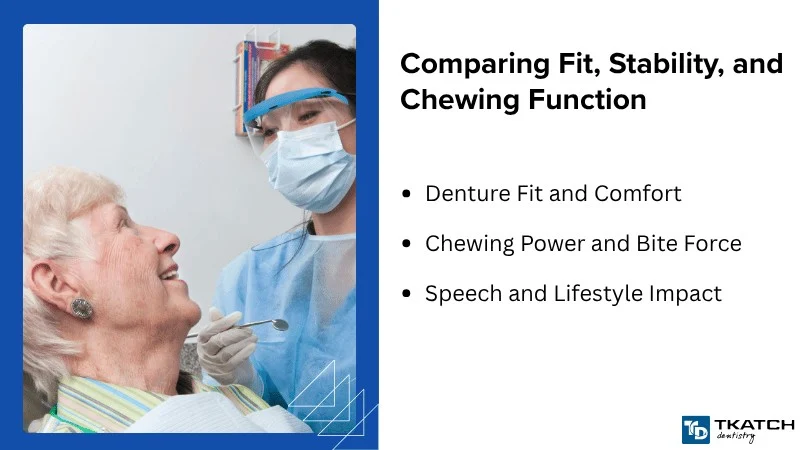
Traditional dentures rest on your gums and rely on suction or adhesives to stay in place. They can shift around when you eat or talk, which many people find frustrating.
Your jawbone changes shape over time, so dentures that fit well today might feel loose in a few months.
You’ll need adjustments every few months to keep them comfortable. Many denture wearers deal with sore spots where the plastic rubs against their gums.
Implant-supported dentures attach to posts in your jawbone, which means they stay firmly in place. You won’t need adhesives or worry about them slipping at awkward moments.
The fit stays consistent because the implants don’t shift like traditional dentures do. Most people say implant dentures feel more natural and cause less irritation to their gums.
Chewing Power and Bite Force
Your ability to eat different foods changes dramatically based on which option you choose. Traditional dentures only give you about 10% of normal chewing power.
That means tough foods like steak, raw carrots, or corn on the cob become nearly impossible to eat.
Implant-supported dentures restore up to 95% of your natural bite force. You can eat almost anything without cutting it into tiny pieces first.
The implants work like tooth roots, so biting down feels similar to having your natural teeth. This difference affects your nutrition too, since you can eat a wider variety of healthy foods.
Speech and Lifestyle Impact
Traditional dentures can make clicking sounds when you talk, especially if they don’t fit perfectly. Some people develop a slight lisp or have trouble pronouncing certain words.
You might feel self-conscious in social situations or avoid speaking up in meetings.
Implant dentures stay stable when you talk, so your speech sounds more natural. You won’t worry about them falling out during important conversations or while laughing with friends.
Your confidence grows when you know your teeth won’t move unexpectedly. This stability helps you restore your smile and feel more like yourself again in everyday situations.
Bone Health and Longevity
Your jawbone needs stimulation to stay healthy, and the type of tooth replacement you choose directly affects whether your bone gets weaker or stays strong.
Traditional dentures sit on top of your gums and don’t help preserve bone, while implant-supported dentures work like natural tooth roots to keep your jawbone active.
![[Tkatch Dentistry] Dental Implant Pricing Guide NGP Magazine + Gift Card](https://www.tkatchdentistry.com/wp-content/uploads/2026/08/Tkatch-Dentistry-Dental-Implant-Pricing-Guide-NGP-Magazine-Gift-Card.webp)
Jawbone Density and Health
When you lose teeth, your jawbone starts to shrink because it no longer gets the pressure and stimulation it needs from chewing.
This process happens gradually but can change the shape of your face over time.
Traditional dentures rest on your gums and don’t stop this bone loss. Your jawbone can lose up to 25% of its width in the first year after tooth loss.
This is why dentures often need adjustments or replacements every few years as your jaw changes shape.
Implant-supported dentures work differently. The titanium implants act like tooth roots and send signals to your jawbone when you chew. This keeps your bone active and healthy.
Implant-supported dentures provide improved functionality and confidence compared to traditional options because they maintain your natural bone structure.
Bone Preservation and Loss
Your body treats missing teeth as a sign that the jawbone isn’t needed anymore. Without stimulation, blood flow to the area decreases and bone cells break down faster than they rebuild.
Traditional dentures speed up this process because they put pressure on your gums but not your bone. The constant rubbing can also create sore spots and make your dentures fit poorly over time.
Implant-supported dentures stop bone loss by mimicking natural teeth. Each implant fuses with your jawbone and keeps it active.
This means your face keeps its natural shape and you avoid the sunken look that often comes with long-term denture use.
The choice between dentures and implants affects your bone health and overall facial structure for years to come.
Osseointegration and Bone Grafting
Osseointegration is the process where titanium implants fuse directly with your jawbone. This creates a strong foundation that can last decades.
The process typically takes three to six months as your bone grows around the implant.
You might need bone grafting if you’ve already experienced significant bone loss. This procedure adds bone material to weak areas of your jaw before implants can be placed.
While it adds time and cost to treatment, it makes implants possible for many people who wouldn’t otherwise qualify.
For severe bone loss, zygomatic implants offer an alternative. These longer implants anchor into your cheekbone instead of your jaw.
Your dentist will evaluate your jawbone density and overall health to determine if you need grafting or if standard implants will work for your situation.
Cost Comparison and Long-Term Value
Traditional full dentures start around $1,500 to $3,000, while implant-supported dentures run $15,000 to $30,000 upfront.
The gap narrows over time as dentures require regular maintenance, adjustments, and eventual replacement.
Denture Cost and Maintenance
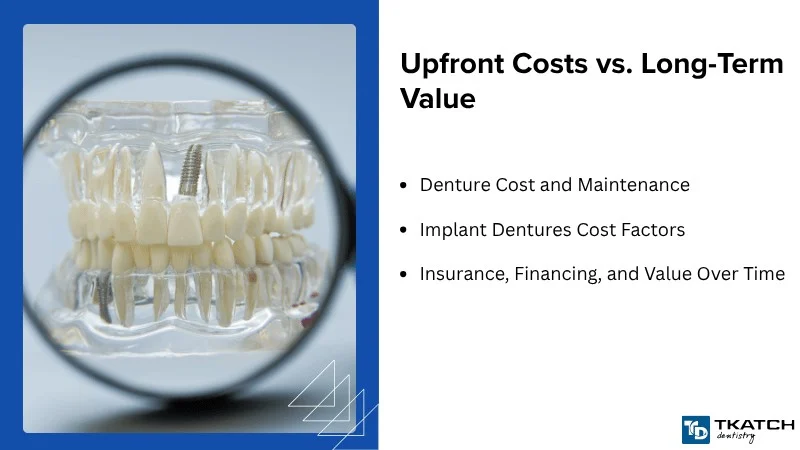
Your initial denture cost covers extractions, fabrication, and first adjustments. Standard full dentures range from $1,500 to $2,500 per arch, while premium versions cost $2,000 to $4,500.
Ongoing expenses add up quickly:
- Annual adjustments and repairs: $500 to $1,500
- Hard reline every 5 years: $400 to $800
- Complete replacement every 7-10 years: $1,500 to $3,000
- Adhesives and cleaning products: $130 to $300 yearly
Over 20 years, you’ll spend $12,000 to $33,000 on dentures when you factor in replacements and maintenance. Your dentures need constant care because bone loss changes how they fit.
Most wearers visit their dentist 2-4 times yearly for adjustments beyond regular checkups.
Implant Dentures Cost Factors
Implant-supported denture pricing depends on how many implants you need. Snap-in denture implants typically use 2-4 implants per arch and cost $15,000 to $25,000. Fixed implant dentures with 4-6 implants run $20,000 to $35,000 per arch.
Your total includes:
- Implant placement surgery: $1,500 to $3,000 per implant
- Abutments and attachments: $1,500 to $2,500
- Custom denture fabrication: $3,000 to $8,000
- Bone grafting if needed: $3,000 to $15,000
Annual maintenance costs only $150 to $300 for professional cleanings. You won’t need adhesives or frequent adjustments. The implants themselves last 20+ years in 90-95% of cases, though you may replace the denture portion once after 10-15 years for $3,000 to $5,000.
Insurance, Financing, and Value Over Time
Most dental insurance covers 0-50% of denture costs up to $1,000 to $1,500 annually. Implant dentures rarely get coverage since insurers consider them elective.
Some plans classify snap-in denture implants as prosthetic devices and provide partial benefits.
Payment plans through CareCredit or in-office financing offer 0% APR for 12-24 months on major tooth replacement options. Dental loans at 5-12% APR spread costs over 3-7 years.
20-year cost comparison:
| Option | Initial | Annual | 20-Year Total |
| Traditional dentures | $2,000-$3,000 | $500-$1,500 | $12,000-$33,000 |
| Implant dentures | $20,000-$30,000 | $150-$300 | $23,000-$36,000 |
The difference shrinks to just a few thousand dollars over two decades. Your implant-supported denture provides better quality of life with normal eating and speaking compared to removable options.
Choosing the Right Solution for Your Needs
Your oral health status and access to qualified specialists will guide you toward the best tooth replacement option.
Understanding your candidacy requirements and knowing which dental professionals to consult helps you make an informed decision.
Assessing Your Oral Health and Candidacy
Your jawbone density plays a major role in determining whether you qualify for implant-supported dentures. The implants need sufficient bone material to anchor securely in your jaw.
If you’ve experienced bone loss from gum disease, tooth loss, or aging, you might need additional procedures first.
Your gum health matters too. Active gum disease must be treated before any implant procedure begins. Healthy gums provide the foundation for successful implant placement and long-term stability.
Key health factors that affect candidacy include:
- Sufficient jawbone density and height
- Healthy gum tissue without active infection
- Controlled diabetes and other systemic conditions
- Non-smoker status or willingness to quit
- Good oral hygiene habits
Regular dental checkups help identify any issues that could affect your treatment success. Your dentist will take X-rays and possibly CT scans to evaluate your bone structure.
They’ll also review your medical history to check for conditions that might complicate healing.
Prosthodontics and the Role of Specialists
Prosthodontics is the dental specialty focused on replacing missing teeth and restoring your mouth’s function. Prosthodontists complete three additional years of training beyond dental school.
They specialize in complex cases involving multiple missing teeth or difficult oral conditions.
These specialists understand how implant-supported dentures interact with your bite, jaw joints, and facial muscles. They coordinate treatment plans that might involve other specialists like oral surgeons or periodontists.
A general dentist can handle traditional dentures for most patients. However, implant-supported dentures often require the expertise of specialists working together.
The prosthodontist designs your final restoration while an oral surgeon may place the implants.
When to See a Prosthodontist or Oral Surgeon
You should consider seeing a prosthodontist when you’re missing multiple teeth or need full-arch restoration. They’re particularly valuable if you have complex needs like jaw alignment issues or previous implant failures.
An oral surgeon becomes necessary when your case requires surgical procedures. They handle implant placement, bone grafting, and tooth extractions.
Many patients see both specialists during their treatment journey.
Schedule a consultation with specialists if you:
- Need to replace most or all of your teeth
- Have experienced bone loss in your jaw
- Want implant-supported options but have been told you’re not a candidate
- Have had unsuccessful dental work in the past
- Need extractions before getting dentures
Your general dentist can refer you to appropriate specialists based on your specific situation.
How to Find a Prosthodontist Near You

Start by asking your current dentist for referrals to trusted prosthodontists in your area. They often work closely with specialists and know who delivers quality care.
The American College of Prosthodontists offers an online directory where you can search by location. Check each prosthodontist’s credentials, years of experience, and patient reviews before scheduling consultations.
When evaluating potential prosthodontists, consider:
- Board certification status
- Years of experience with implant-supported dentures
- Technology and techniques they use
- Patient testimonials and before-after photos
- Payment options and insurance acceptance
Schedule consultations with two or three specialists to compare treatment approaches and costs. Ask about their success rates and how they handle complications.
A good prosthodontist will explain your options clearly and answer all your questions without rushing you.
During your visits, pay attention to how the office maintains hygiene standards. They should discuss proper care techniques, including using an interdental brush to clean around implant abutments.
The right specialist makes you feel comfortable and confident about your treatment plan.
Frequently Asked Questions
Cost varies widely based on materials and type, while financing options and community programs can help make dentures accessible even on limited budgets.
Newer technologies offer better comfort than older designs, and implant-supported options provide stability advantages that affect daily activities like eating and speaking.
How much does a full set of dentures usually cost, and what factors can change the price?
A full set of traditional dentures typically costs between $450 and $6,500 per arch. The wide price range depends on the materials used and the type of dentures you choose.
Basic dentures made with standard acrylic materials fall on the lower end of this range. Premium dentures use higher-quality materials that look more natural and last longer, pushing the cost higher.
The dentist’s experience and your location also affect pricing. Urban areas and specialists often charge more than rural practices or general dentists.
Custom fitting and additional adjustments add to the total cost. Some dentists include follow-up visits in their initial quote, while others charge separately for these services.
What are some realistic ways to afford dentures if I’m on a very tight budget or have no savings?
Dental schools offer dentures at reduced prices because students perform the work under supervision. You’ll pay significantly less than at a private practice, though appointments take longer.
Many dentists offer various dental financing options that let you spread costs over several months. These plans often don’t require a credit check and come with low or no interest if you pay on time.
Medicaid covers dentures in some states for eligible adults. Check your state’s specific dental benefits to see what’s included.
Nonprofit organizations and community health centers sometimes provide free and low-cost dental care options for seniors and low-income individuals. Local dental societies can point you to programs in your area.
CareCredit and similar healthcare credit cards offer promotional financing for dental work. You’ll need decent credit to qualify, but you might get interest-free periods if you pay off the balance quickly.
Where can I look for low-cost dentures near me without sacrificing too much on quality?
Community health centers that receive federal funding often provide dental services on a sliding fee scale based on income. These facilities maintain quality standards while keeping costs accessible.
Dental schools in your area train future dentists who need real patients for practice. Faculty members supervise all work closely, ensuring you receive proper care at a fraction of typical costs.
Some private dental practices advertise low-cost denture specials or have in-house discount plans. Call around to compare prices and ask exactly what’s included in the quoted price.
Veterans Affairs (VA) dental benefits cover dentures for eligible veterans. Contact your local VA health facility to learn about your specific eligibility.
Online directories for federally qualified health centers help you find affordable dental clinics nearby. These centers serve everyone regardless of ability to pay.
What are the newest denture options available today, and how do they compare for comfort and durability?
Modern dentures have improved significantly in both comfort and appearance compared to older designs. New materials and manufacturing techniques create dentures that fit better and look more natural.
Digital dentures use 3D scanning and printing technology for more precise fits. This method often requires fewer adjustment appointments and provides better comfort from the start.
Flexible partial dentures made from thermoplastic materials offer a lighter, more comfortable alternative to traditional metal-clasp partials. They bend slightly with your mouth movements and blend in better aesthetically.
Premium denture teeth now come in multiple shade gradients and translucencies that mimic natural tooth enamel. These higher-end options look much more realistic than basic denture teeth.
Most modern dentures last five to 10 years with proper care. The exact lifespan depends on the quality of materials and how well you maintain them.
How do implant-supported dentures compare to traditional dentures in ongoing maintenance and daily lifestyle impact?
Implant-supported dentures stay much more stable when you eat and talk compared to traditional dentures. You won’t need adhesives to keep them in place, which saves money and eliminates the messy application process.
Traditional dentures require daily removal for cleaning and soaking overnight. Implant-supported dentures can be either removable or permanent, depending on the type you choose.
You can eat a wider variety of foods with implant-supported dentures because they don’t shift or slip. Traditional dentures often make it difficult to eat tough or sticky foods.
Removable implant-supported dentures that snap onto posts cost around $2,500, while permanent versions run about $4,000 per arch.
Traditional dentures cost less upfront but may need more frequent adjustments and replacements.
Implant posts require the same care as natural teeth with regular brushing and flossing. Traditional dentures need special cleaning solutions and careful handling to prevent warping or damage.
Do implant-supported dentures cover the roof of the mouth, and how does that affect taste, comfort, and speech?
Many implant-supported dentures don’t need to cover the roof of your mouth because the implant posts provide stability. Traditional upper dentures must cover your palate to create suction for staying in place.
Leaving the roof of your mouth uncovered lets you taste food better. Your palate contains taste receptors that get blocked when covered by a denture base.
Speech feels more natural without palate coverage because your tongue moves more freely. Many people find it easier to pronounce certain sounds clearly.
The open design also feels more comfortable and less bulky in your mouth. You won’t experience the gagging sensation that sometimes happens with full palate coverage.
Temperature sensitivity improves when your palate stays uncovered. You’ll better sense whether foods and drinks are hot or cold, making eating more enjoyable and safer.