
If you have diabetes or osteoporosis and you’ve lost a tooth, you may worry that implants are off the table. That worry is common, and it’s worth clearing up early.
Neither diabetes nor osteoporosis automatically disqualifies you from dental implants, though both conditions can change how your treatment is planned and how long healing takes.
In fact, dentists report that neither condition rules out implant treatment on its own, but each one calls for closer attention to bone quality, blood sugar, and follow-up care.
Systemic diseases matter because they touch the same processes an implant depends on: bone repair, blood flow, and your immune response.
Research on bone healing around implants in medically compromised patients points to these disruptions as the main reason healing can slow down.
Below, you’ll see how each condition affects your eligibility, what your dentist will check before surgery, and the simple steps that give your implant its best shot at lasting success.
Key Takeaways
- Diabetes and osteoporosis can slow healing, but they rarely rule out implant treatment on their own.
- Steady blood sugar, a review of your bone medications, and careful surgical planning all improve your odds.
- Regular checkups after placement help catch infection or bone loss while it’s still easy to treat.
Table of Content
- How Diabetes and Osteoporosis Influence Implant Healing
- Dental Implant Eligibility and Glycemic Control With Diabetes
- Osteoporosis, Bone Medications, and Dental Implant Planning
- Risks to Monitor After Implant Placement
- Steps to Improve the Chances of a Successful Outcome
- What the Research Says and Its Limits
- Frequently Asked Questions
How Diabetes and Osteoporosis Influence Implant Healing
Both diabetes and osteoporosis change the way your jawbone builds new tissue around a titanium post, but they do it in different ways.
One affects the quality of healing through blood sugar and blood flow, while the other affects the amount and density of bone available to hold the implant in place.
Osseointegration and Bone Remodeling
Osseointegration is the process where your jawbone grows directly against the surface of the implant and locks it in place. It usually takes about three to six months.
Here’s the basic order of events:
- Blood clots form around the implant right after surgery.
- New blood vessels grow in a process called angiogenesis, bringing oxygen and healing cells.
- Osteoblasts (bone-building cells) lay down fresh bone on the implant surface.
- Bone remodeling replaces that early woven bone with stronger, organized bone.
Your body balances bone building against bone resorption, the breakdown of old bone.
Systemic conditions that disturb bone metabolism, angiogenesis, and immune regulation can slow this sequence down and raise the risk of a loose or failing implant.
Why Blood Sugar Changes Healing
Chronic hyperglycemia (blood sugar that stays high over months) makes healing harder in several ways at once.
High glucose leads to advanced glycation end products (AGEs), sticky molecules that build up in collagen and stiffen bone tissue. They also trigger chronic inflammation and reduce how well osteoblasts do their job.
High blood sugar narrows small blood vessels too, so less oxygen reaches the surgical site. The result is delayed wound healing and a weaker immune response, which makes gum infection around the implant more likely.
The good news: glycemic control matters more than the diagnosis itself. Well-managed diabetes with a stable A1c usually allows normal osseointegration, while poorly controlled diabetes is linked to slower healing and more peri-implant problems.
Even prediabetes appears to raise the chance of gum inflammation around implants without clearly lowering survival rates.
How Low Bone Density Affects Stability
Osteoporosis is mostly a problem of quantity and structure. Bone resorption outpaces bone formation, so the internal scaffolding of your jaw becomes thinner and more porous.
That matters at two points:
| Stage | What low bone density does |
| Day of surgery | Less primary stability — the implant may not grip as tightly |
| First 3–6 months | Slower bone fill, so secondary stability builds up more gradually |
Reduced bone quality doesn’t rule you out. Researchers comparing osteoporosis and diabetes effects on implant stability over 12 months found both groups can reach stable results, though the healing curve looks different.
Your dentist may respond with a longer healing period, wider or textured implants, or a bone graft.
Medications matter as well; bisphosphonates and other bone drugs can influence success rates, so share your full medication list before surgery.

Dental Implant Eligibility and Glycemic Control With Diabetes
Having diabetes does not automatically mean you are not a dental implant candidate, but your blood sugar numbers, gum health, and healing history matter.
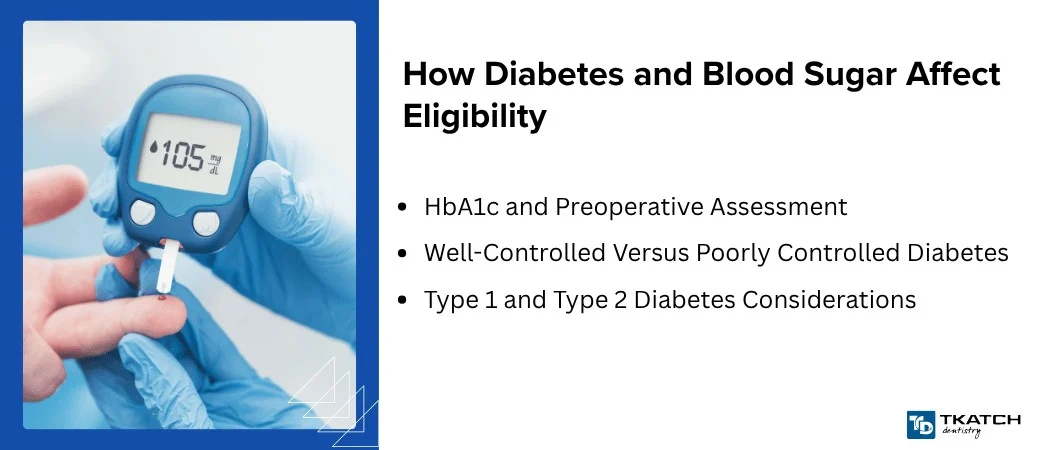
HbA1c and Preoperative Assessment
Your HbA1c test shows your average blood sugar over the past two to three months. It gives your dental team a clearer picture than a single fingerstick reading.
Most clinicians want to see an HbA1c under 7%, though many will treat patients up to about 8%. Some dental guidelines on glycemic targets line up with the goals set by major diabetes groups.
Before surgery, expect your dentist to:
- Request recent lab work (usually within the last 3 months)
- Contact your physician to confirm your diabetes is stable
- Check your gums for infection, bleeding, and bone loss
- Review your medications, including insulin timing on surgery day
Good coordination between your medical and dental teams helps lower your risk of problems.
Well-Controlled Versus Poorly Controlled Diabetes
When your glucose stays in a healthy range, your implant success rate is close to that of non-diabetic patients.
Research on implant failure and peri-implant conditions found that people with type 2 diabetes and good control had outcomes similar to people without diabetes.
Poorly controlled diabetes is a different story. High blood sugar slows wound healing, weakens your immune response, and raises the odds of infection around the implant.
| Glycemic Status | What It Usually Means for Treatment |
| HbA1c below 7% | Standard treatment plan, routine healing time |
| HbA1c 7–8% | Often acceptable, with closer monitoring |
| HbA1c above 8% | Surgery usually delayed until numbers improve |
Even bone grafting can work well. One review found that patients with moderate or good control had bone gains comparable to non-diabetic patients after guided bone regeneration.
Type 1 and Type 2 Diabetes Considerations
Both type 1 and type 2 diabetes can affect osseointegration, which is how bone locks onto the implant surface. The bigger factor is your control, not your diagnosis.
If you have type 1 diabetes, you may have lived with the condition longer, so your dentist will watch for kidney, eye, or circulation issues that affect healing.
With type 2 diabetes mellitus, extra attention often goes to gum inflammation and daily oral hygiene.
Even prediabetes deserves a look, since research on prediabetes and implant success points to effects on bone metabolism and immune function.
Your dentist may also space out follow-up visits more closely and allow extra healing time before attaching your crown.
Osteoporosis, Bone Medications, and Dental Implant Planning
Having osteoporosis doesn’t rule you out of implant treatment, but it does change how your dentist plans the surgery.
The main things they’ll look at are how much bone you have in the jaw, what medications you take for your bones, and whether you need extra bone added before an implant can go in.
Assessing Bone Volume and Implant Site Quality
Your dentist starts with a 3D scan, usually a cone beam CT. This shows the height, width, and density of bone at each planned implant site.
Osteoporosis and osteopenia lower bone density throughout your skeleton, but your jaw may still have plenty of solid bone. That’s why osteoporosis by itself is not considered a contraindication for implants.
Decisions come down to the bone quality at the actual site.
Softer bone changes the surgical approach. Your dentist may use a slower drilling technique, pick a wider or longer implant, and wait longer before attaching the crown.
Expect follow-up scans too. Tracking marginal bone loss and crestal bone loss around the implant helps catch problems early.
Good calcium and vitamin D levels also support healing, so your doctor may check those and suggest supplements.
Bisphosphonates and MRONJ Risk
Bisphosphonates slow down the cells that break down old bones. That helps your spine and hips, but it also means the jaw remodels more slowly after surgery.
The concern is medication-related osteonecrosis of the jaw, or MRONJ, where bone in the jaw fails to heal and becomes exposed.
Risk goes up with:
- Injected or IV bisphosphonates instead of pills
- Longer use, especially past four years
- Steroids, smoking, or poorly controlled diabetes alongside the drug
Bring your exact drug name, dose, and start date to your consultation. Never stop these medications on your own.
As osteoporosis drugs change how bone remodels, any pause needs a conversation between your dentist and prescribing doctor.
When Bone Grafting May Be Needed
If a scan shows too little bone to hold an implant, you may end up needing a bone graft before a dental implant can be placed securely.
This is common in the back of the upper jaw, where bone is naturally thinner and sinuses sit close by.
If tooth extraction is necessary before implant placement, your dentist may recommend socket preservation to help limit bone loss at the site.
Common options include:
| Procedure | What it does |
| Socket preservation | Fills a fresh extraction site to limit bone loss |
| Guided bone regeneration | Uses a membrane and graft material to rebuild width or height |
| Sinus lift | Raises the sinus floor to create room for upper back implants |
| Block graft | Adds a solid piece of bone for larger defects |
Bone augmentation heals more slowly when bone turnover is reduced, so plan on several months between the graft and implant placement.
Your dentist may also stage treatment, placing fewer implants at a time and checking healing before moving forward.
Risks to Monitor After Implant Placement
Getting your implant placed is only part of the process.
Diabetes and osteoporosis can both change how your bone and gums respond in the months and years that follow, so you and your dentist will want to watch for slow integration, gum infection, and bone loss around the implant.
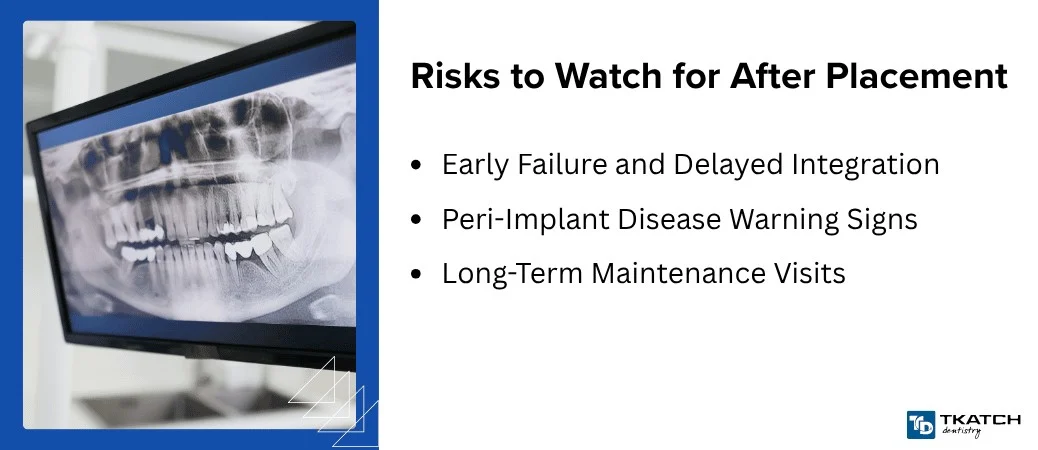
Early Failure and Delayed Integration
The first few months matter most. Your implant needs to bond with your jawbone, a process called osseointegration, and high blood sugar or thin bone can slow it down.
One study tracking implant stability at 6 and 12 months compared people with diabetes and osteoporosis to see how firmly implants held over time.
Research also points to a higher implant failure rate in people with diabetes compared to those without it.
Signs that something is off include:
- An implant that feels loose or moves slightly
- Pain that gets worse after the first week instead of better
- Swelling or drainage that does not settle down
Tell your dentist right away if you notice any of these. Catching a problem early sometimes means the site can be cleaned, allowed to heal, and re-treated later.
Peri-Implant Disease Warning Signs
Peri-implant problems come in two stages. Peri-implant mucositis is gum inflammation only, and it can usually be reversed with better cleaning. Peri-implantitis goes further and includes bone loss around the implant.
Your dentist checks for this by measuring probing depth and looking for bleeding on probing. Deeper pockets and bleeding often come before marginal bone loss shows up on an X-ray.
Poorly controlled diabetes is linked to more peri-implant inflammation and faster crestal bone loss.
That is partly because high blood sugar raises pro-inflammatory cytokines like IL-6, IL-1β, and TNF-α, which push bone resorption along.
Smoking and a history of periodontitis add to the risk.
Long-Term Maintenance Visits
Plan on more frequent checkups than the standard twice a year. Many dentists suggest every three to four months if you have diabetes or osteoporosis.
At these visits, your dentist or hygienist will:
- Clean around the implant with tools that won’t scratch the surface
- Record probing depths and any bleeding
- Take X-rays to compare bone levels over time
- Check that your crown and bite still fit correctly
Keeping your A1C in a steady range helps too, since medical conditions change how implant sites heal.
Brush twice daily, clean between the implant and nearby teeth every day, and mention any new medications, especially bone drugs, at each appointment.
Steps to Improve the Chances of a Successful Outcome
Good results with dental implant therapy usually come down to three things: getting your health numbers in a good range before surgery, picking a treatment plan that matches your bone quality, and sticking with a cleaning and checkup routine afterward.
Each step gives your body a better shot at healing well around the implant.
Coordinating Care With Medical Providers
Your dentist and your doctor should be talking to each other before surgery day.
Ask your physician for a recent A1c reading. Research shows that well-controlled diabetic patients have success rates similar to healthy individuals, so getting your glycemic control steady first is one of the most useful things you can do.
Bring a full list of medications, including bisphosphonates or other bone drugs, since your surgeon may want to adjust timing.
It also helps to mention related systemic diseases. Hypertension, cardiovascular disease, obesity, and metabolic syndrome can all affect healing and wound care, and your care team can plan around them.
If you smoke, ask for help quitting. Smoking raises the risk of implant failure on its own, and it adds to the risk that diabetes already brings.
Choosing Implant Timing, Loading, and Restoration Options
Not every mouth is ready for the fastest approach.
Your surgeon will check bone volume and density with a 3D scan before planning implant placement.
Because bone support plays an important role in dental implant installation, thin or insufficient bone may require bone augmentation or a sinus lift first.
Immediate loading, where a tooth goes on the implant the same day, works best when initial implant stability is high.
With diabetes or osteoporosis, many clinicians prefer a staged plan and give the implant three to six months to fuse before adding the crown.
Other choices that matter:
| Decision | What to talk about |
| Number of implants | More implants spread out the chewing force |
| Restoration type | Screw-retained crowns are easier to clean and repair |
| Bridge vs. single crowns | Fewer connected units means simpler hygiene access |
If you’re replacing multiple missing teeth, your dentist will also decide whether implants or an implant-supported bridge offers the better approach.
Building a Personalized Prevention Plan
Peri-implant health depends on daily habits more than anything else after the crown goes on.
Brush twice a day, and use a water flosser or interdental brushes around the implant. Poorly controlled diabetes is linked to more peri-implantitis and crestal bone loss, so plaque control around the implant really does pay off.
Ask about a cleaning schedule of every three to four months instead of twice a year.
Keep up with your general health, too. Steady blood sugar, adequate calcium and vitamin D, and any osteoporosis treatment your doctor recommends all support the bone that holds your implant rehabilitation in place.
Report bleeding, swelling, or a loose crown right away. Early treatment usually saves the implant.
What the Research Says and Its Limits
Studies generally show that dental implants can work well for people with diabetes or osteoporosis, but the quality of that evidence varies a lot.
Knowing what researchers measured, and what they left out, helps you ask better questions before you agree to surgery.
Findings From Systematic Reviews and Clinical Studies
Most of what we know comes from systematic reviews that pool together cohort studies, retrospective chart reviews, and a smaller number of randomized controlled trials.
One review following PRISMA guidelines searched databases through 2025 and reported that implant therapy can succeed in well-controlled diabetes, while poor blood sugar control raises the risk of peri-implant problems and failure.
For osteoporosis, a comparison of bone quality and healing in both conditions found that each affects the process differently, even though both can slow osseointegration.
Researchers are also testing implant designs. A review of surface modifications that improve osseointegration suggests treated surfaces may help in compromised bone, though much of that data comes from animal or short-term studies.
Questions to Discuss at Your Consultation

Bring a short list. It keeps the conversation focused and helps you compare providers.
Worth asking:
- What is my recent A1C, and do you want it lower before surgery?
- Have you placed implants in patients with my condition, and what happened over five years?
- Will you use a staged approach with a longer healing period?
- How will my osteoporosis medication affect the timing?
- What does success mean in the numbers you are quoting me?
It also helps to ask how your surgeon and your physician will share information.
Frequently Asked Questions
Diabetes and osteoporosis both affect how your jaw heals around an implant, but neither one automatically rules you out. Here are straight answers about blood sugar targets, bone medications, and the daily habits that support a good result.
Can I get dental implants if I have diabetes?
Yes, in most cases. People with well-controlled diabetes can get dental implants and see success rates close to those of people without diabetes.
Your dentist will look at your A1C, your gum health, and how much bone you have. They may also talk with your doctor before scheduling surgery.
Poorly managed blood sugar is a different story. It raises the chance of infection and slow healing, so treatment is often delayed until your numbers improve.
How does diabetes affect dental implant healing?
Implants work because bone grows around the metal post and locks it in place. That process is called osseointegration, and it takes a few months.
High blood sugar slows this down. It can reduce blood flow to small vessels, weaken the immune response, and make gum infections more likely.
That is why healing timelines can differ for people with certain medical conditions. Your dentist may schedule extra check-ups during the first few months.
Do I need to have my blood sugar under control before getting implants?
Yes, and this is one of the biggest factors in your outcome. Many dental teams want to see an A1C level and steady glycemic control before moving ahead with surgery.
There is no single number that every office uses. Many aim for an A1C under 7%, though some will treat patients with slightly higher readings if the rest of their health is stable.
Bring your recent lab results to your consultation. It saves time and helps your dentist plan around your real numbers instead of estimates.
Can osteoporosis make dental implants less successful?
Osteoporosis lowers bone density throughout your body, including your jaw. Thinner or softer bone can make it harder for an implant to stay stable during healing.
Still, having osteoporosis does not automatically prevent implant treatment. Jaw bone often holds up better than bone in the hip or spine.
Your dentist will use a 3D scan to check the width, height, and quality of your bone. If there is not enough, a bone graft may be suggested first.
Are osteoporosis medications safe to take before or after dental implant surgery?
Bisphosphonates like Fosamax and Reclast change how quickly your bone rebuilds itself. That matters for implants, since healing depends on new bone growth.
The risk depends on the dose, how long you have taken the drug, and whether you take it by mouth or by IV. IV forms used in cancer care carry more concern than low-dose pills for osteoporosis.
Never stop a prescribed bone medication on your own. Your dentist and your prescribing doctor should coordinate that decision together, and the same goes for blood thinners.
What can I do to improve my chances of successful implant healing?
A few habits make a real difference:
- Keep your blood sugar steady in the weeks before and after surgery, not just on the day of your appointment.
- Quit or cut back on smoking. Nicotine narrows blood vessels and slows healing at the implant site.
- Brush and floss around the implant daily, and use any special cleaning tools your hygienist recommends.
- Eat enough protein, calcium, and vitamin D while your bone is rebuilding.
- Show up for every follow-up visit, since early gum inflammation is much easier to treat than late-stage bone loss.
Tell your dental team about every medication and supplement you take. Small details, like a steroid or an immune-suppressing drug, can change how your care is planned.