If you struggle with a CPAP mask every night, you may wonder if you have other options. Many people look for sleep apnea treatments that feel less bulky and easier to use.
Oral appliance therapy often comes up as a simple, travel‑friendly choice.
Yes, oral appliance therapy for sleep apnea can treat mild to moderate obstructive issues, but CPAP remains the most effective option for severe cases.
Oral appliances are small dental devices that keep your airway open while you sleep. You wear them in your mouth, not over your face.
These devices work by moving your jaw or tongue forward to improve airflow.
Research also shows that while CPAP works best overall, many people find oral appliances easier to use, as explained in this comparison of CPAP vs. oral appliance therapy.
When you understand how each option works, you can choose a plan for treating sleep apnea that fits your life.
Key Takeaways
- Oral appliance therapy can treat mild to moderate obstructive sleep apnea.
- CPAP remains the most effective treatment, especially for severe cases.
- Choosing the right option depends on comfort, severity, and long-term use.
Table of Content
- Understanding Sleep Apnea and Its Symptoms
- CPAP Therapy: How It Works and Its Challenges
- Oral Appliance Therapy for Sleep Apnea
- Comparing Effectiveness: CPAP vs. Oral Appliances
- Other CPAP Alternatives and Emerging Treatments
- Frequently Asked Questions
Understanding Sleep Apnea and Its Symptoms
Sleep apnea is a sleep disorder that causes repeated pauses in breathing during the night. These pauses lower your sleep quality, strain your body, and often go unnoticed until symptoms grow worse.
Types of Sleep Apnea: OSA and CSA
Sleep apnea has two main forms: obstructive sleep apnea (OSA) and central sleep apnea (CSA).
OSA is the most common type. It happens when your throat muscles relax too much during sleep. This leads to airway collapse, which blocks airflow even though your body tries to breathe.
Loud snoring, gasping, and choking sounds often occur with OSA.
CSA is less common. It happens when your brain does not send steady signals to control breathing. Your airway may stay open, but your body briefly stops making the effort to breathe.
Both types can reduce oxygen levels and disturb your sleep cycle.
Recognizing Sleep Apnea Symptoms and Severity
Common sleep apnea symptoms include:
- Loud, frequent snoring
- Gasping or choking during sleep
- Morning headaches
- Dry mouth upon waking
- Ongoing daytime fatigue
- Trouble focusing
You may not notice the breathing pauses yourself. A partner often sees repeated episodes of stopped breathing or shallow breathing called hypopnea.
Doctors measure sleep apnea severity using the apnea-hypopnea index (AHI). This number shows how many apneas and hypopneas happen per hour of sleep.
- Mild: 5–14 events per hour
- Moderate sleep apnea: 15–29 events per hour
- Severe sleep apnea: 30 or more events per hour
People with mild to moderate obstructive sleep apnea may have fewer symptoms but still face health risks if they ignore treatment.
Risks of Untreated Sleep Apnea
When you leave sleep apnea untreated, your body works harder every night.
Each breathing pause lowers oxygen levels and forces brief awakenings. These repeated drops strain your heart and blood vessels. Over time, this raises your risk for high blood pressure, heart disease, and stroke.
Poor sleep quality also affects your daily life. You may struggle with memory, mood changes, and low energy. Ongoing daytime fatigue increases your risk of work errors and car accidents.
Sleep apnea rarely goes away on its own. Treatment aims to prevent airway collapse, keep oxygen levels stable, and restore steady breathing so your body can fully rest.

CPAP Therapy: How It Works and Its Challenges
CPAP therapy uses steady air pressure to keep your airway open while you sleep. It works well for many people, but comfort and daily use can be hard for some.
CPAP Machine and CPAP Masks Explained
A CPAP machine delivers continuous positive airway pressure through a tube and into a CPAP mask that you wear at night.
The steady stream of air keeps your throat from collapsing and stops pauses in breathing caused by obstructive sleep apnea.
You can choose from several mask types:
- Nasal masks that cover your nose
- Nasal pillows that sit at the nostrils
- Full-face masks that cover your nose and mouth
The goal is simple: keep your airway open all night. CPAP therapy is the most common treatment for obstructive sleep apnea because it reduces breathing interruptions better than most other options.
You must use your machine every night for it to work well. Insurance often requires proof that you use it for a set number of hours.
CPAP Side Effects and Common Complaints
CPAP therapy works, but you may notice side effects at first. These problems often improve with small changes.
Common CPAP side effects include:
- Dry mouth
- Mask discomfort
- Nasal congestion
- Feeling closed in by the mask
Dry mouth can happen if air leaks from your mouth. A heated humidifier or a chin strap can help. Nasal congestion may improve with a humidifier or a different mask style.
Mask discomfort is one of the biggest complaints. A mask that is too tight can cause skin marks or soreness. A poor fit can cause air leaks and noise. Your provider can adjust the fit or switch mask types.
Some people stop CPAP because they feel bothered by the air pressure. Before quitting, ask about pressure changes or different PAP machines.
Other Positive Airway Pressure Devices: BiPAP, APAP, ASV
CPAP is only one type of positive airway pressure device. Other PAP machines adjust airflow in different ways.
BiPAP (also called BPAP) gives you two pressure levels:
- Higher pressure when you breathe in
- Lower pressure when you breathe out
This setup can feel more natural if you struggle to breathe out against steady pressure.
APAP, or auto-adjusting positive airway pressure, changes the pressure during the night based on your breathing. It increases pressure when your airway starts to narrow and lowers it when you breathe normally.
ASV, or adaptive servo-ventilation, treats certain types of central sleep apnea. It adjusts pressure breath by breath.
If standard CPAP therapy feels hard to tolerate, your sleep specialist may suggest one of these devices before you move to other treatments.
Oral Appliance Therapy for Sleep Apnea
Oral appliance therapy uses a small device you wear in your mouth during sleep. It moves your jaw or tongue to keep your airway open and reduce breathing pauses.
How Oral Appliances Work

When you have obstructive sleep apnea, the soft tissues in your throat relax and block airflow. An oral appliance keeps this space open by changing the position of your lower jaw or tongue.
Most devices move your lower jaw slightly forward. This action pulls the base of your tongue away from the back of your throat. It also tightens the soft tissues in the airway.
You wear the device only at night. You remove it in the morning.
Unlike CPAP, which pushes air into your airway, oral appliance therapy works by adjusting your anatomy.
Oral appliances treat obstructive sleep apnea. They do not treat central sleep apnea, which involves a brain signal problem rather than a blocked airway.
Types of Oral Appliances: MADs and TRDs
Two main types of oral appliances for sleep apnea are used in adults:
- Mandibular advancement devices (MADs)
- Tongue-retaining devices (TRDs)
A mandibular advancement device (MAD), also called a mandibular advancement splint (MAS), fits over your upper and lower teeth. It gently moves your lower jaw forward. Some models adjust over time to improve comfort and effect.
A tongue-retaining device (TRD) uses suction to hold your tongue forward in a small bulb that rests outside your lips. This position helps prevent the tongue from collapsing backward.
Many patients prefer MADs over TRDs because they feel more natural in the mouth. TRDs may help if you cannot use a jaw-based device.
Avoid using an over-the-counter oral appliance without medical guidance. These devices may not fit well and may not treat your apnea safely.
Effectiveness and Suitability for Different Patients
CPAP remains the most effective treatment for sleep apnea. Doctors often recommend it first because it controls breathing events more reliably. You can compare CPAP vs. oral appliance therapy for sleep apnea.
Still, oral appliance therapy works well for many people with mild to moderate obstructive sleep apnea. It also helps if you cannot tolerate CPAP due to mask leaks, noise, or discomfort.
Real-world use matters. Many people wear oral appliances more consistently than CPAP. Higher long-term use can improve results for some patients.
You may be a good candidate if you:
- Have mild or moderate OSA
- Cannot tolerate CPAP
- Prefer a small, travel-friendly device
- Snore but do not have severe apnea
A sleep specialist should confirm your diagnosis before you start sleep apnea treatment.
Fitting, Customization, and Potential Side Effects
A dentist trained in dental sleep medicine should fit your device. Custom oral appliances fit your teeth and jaw shape. This improves comfort and reduces problems.
The dentist adjusts your mandibular advancement device over time. Small changes move your jaw forward in steps. You may need follow-up visits to fine-tune the fit.
Common side effects include:
- Jaw discomfort
- Tooth soreness
- Dry mouth or excess saliva
- Bite changes over time
Some people develop TMJ symptoms, such as joint pain or clicking. Long-term use can shift how your upper and lower teeth meet.
Most side effects are mild and improve as you adjust. Regular dental checks help catch bite changes early and protect your oral health.
Comparing Effectiveness: CPAP vs. Oral Appliances
CPAP and oral appliance therapy both treat obstructive sleep apnea, but they work in different ways. Your results depend on how severe your sleep apnea is and how well you can stick with the treatment.
Treatment for Obstructive Sleep Apnea by Severity
CPAP uses steady air pressure to keep your airway open while you sleep. Doctors often recommend it first because it lowers the apnea-hypopnea index (AHI) more than other options.
The most common treatments for obstructive sleep apnea include CPAP and mandibular advancement splints.
For moderate to severe sleep apnea, CPAP often gives the strongest clinical results. Many sleep doctors start here, especially if your sleep study shows a high AHI or low oxygen levels.
Oral appliance therapy works best for mild to moderate obstructive sleep apnea. In these cases, real-world results can be similar to CPAP, especially if you wear the device every night.
Some experts note that oral appliances can offer comparable effectiveness in mild to moderate cases.
If you cannot tolerate CPAP, an oral appliance may serve as one of the main alternatives to CPAP. A sleep clinician will review your sleep study or home sleep test before recommending a change in sleep apnea treatment.
Comfort, Compliance, and Quality of Sleep
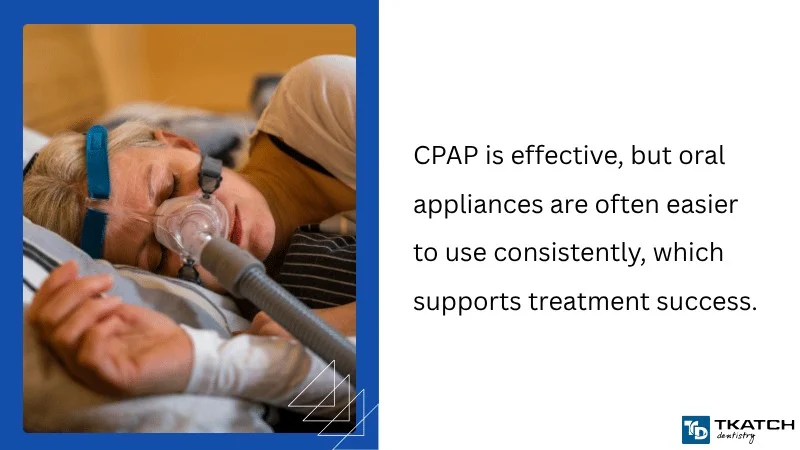
CPAP is very effective, but some people struggle with the mask, noise, or air pressure. Studies show that a large number of patients do not use CPAP as prescribed.
Oral appliance therapy fits like a custom mouthguard. It moves your lower jaw forward to keep your airway open. Many people find it quieter and easier to travel with.
Even though CPAP lowers AHI more, oral appliances may lead to similar health results in some patients because they use the device more often.
Research comparing CPAP vs oral appliance therapy for sleep apnea explains that comfort and side effects differ between the two.
When you choose between CPAP alternatives, daily use matters. A treatment only works if you wear it through the night.
Choosing the Right Therapy With a Sleep Doctor
You should not choose a device on your own. A sleep doctor will base your plan on your sleep study results, symptoms, and medical history.
If you have severe obstructive sleep apnea, your doctor may advise CPAP first. If you have mild or moderate disease, or if you cannot tolerate CPAP, oral appliance therapy may be a good option.
Some clinics now focus on shared decision-making. This means your sleep clinician explains the benefits and limits of each sleep apnea treatment, then asks about your comfort, lifestyle, and goals.
You may need follow-up visits and another sleep study to confirm that your treatment works. Treating sleep apnea takes ongoing care, but the right plan can improve your sleep and protect your long-term health.
Other CPAP Alternatives and Emerging Treatments
You have more than one option if you cannot tolerate CPAP. Some devices use air pressure in different ways, while others rely on body position, surgery, or weight loss to reduce airway collapse.
Expiratory Positive Airway Pressure: EPAP Devices
Expiratory positive airway pressure (EPAP) devices are small, disposable valves that fit over your nostrils. Unlike CPAP, they do not use a machine or hose.
When you breathe in, the valve opens easily. When you breathe out, it creates resistance. This back pressure helps keep your airway open during the next breath.
EPAP may help if you have mild to moderate obstructive sleep apnea and want a quieter, travel-friendly option. It does not work well for everyone, especially if you have severe OSA or nasal blockage.
Continuous negative external pressure (CNEP) works in the opposite way. It applies gentle suction around your chest to support breathing. This approach is still uncommon and not widely used at home.
Positional Therapy and Side Sleeping
Your sleep position can strongly affect your apnea. Many people have more breathing events when they lie on their back.
Positional therapy trains you to sleep on your side. Some people sew a tennis ball into the back of a pajama top. Others use special belts or vibrating devices that prompt you to roll over.
Research shows that CPAP reduces more breathing events, but positional therapy often has better nightly use.
Side sleeping works best if you have positional sleep apnea, meaning your breathing improves when you avoid your back. It may not control moderate to severe OSA on its own.
Surgical Options and Hypoglossal Nerve Stimulation
Sleep apnea surgery changes the shape or position of your airway. Doctors usually suggest it when CPAP and oral appliances fail.
Common procedures include:
- Uvulopalatopharyngoplasty (UPPP), which removes excess tissue from the throat
- Maxillomandibular advancement, which moves the upper and lower jaws forward
- Nasal or tongue-base surgeries
Maxillomandibular advancement often lowers the apnea-hypopnea index more than soft tissue surgery alone, but it requires major facial surgery.
Hypoglossal nerve stimulation is a newer option. A small device stimulates the nerve that controls your tongue, keeping it from collapsing backward.
This therapy appears in several reviews of non-mask sleep apnea treatments.
You must meet strict criteria, including a certain body weight and airway pattern, to qualify.
Lifestyle Modifications and Medication Innovations

Weight loss can reduce airway collapse and lower your apnea-hypopnea index. Even a 10% weight reduction can make a meaningful difference.
Newer medications such as GLP-1 drugs, including semaglutide and tirzepatide (sold as Zepbound), promote weight loss.
Some studies show these drugs lower breathing events in people with obesity and OSA, though no drug is approved only for sleep apnea.
Other supportive approaches include:
- Myofunctional therapy, which strengthens tongue and throat muscles
- Limiting alcohol before bed
- Regular exercise
These steps often work best as part of a broader treatment plan, not as a stand‑alone cure.
Frequently Asked Questions
Oral appliances can move your jaw or tongue to keep your airway open at night. They work best for certain people, and cost, fit, and device safety all matter when you choose one.
How does an oral appliance help keep your airway open during sleep?
An oral appliance repositions your lower jaw or tongue while you sleep. This change creates more space in the back of your throat so air can move through.
The most common type is a mandibular advancement device. It gently moves your lower jaw forward, which also shifts your tongue away from your airway.
Some devices use suction to hold your tongue forward. You wear the device every night and remove it in the morning. Consistent use helps reduce breathing pauses and snoring.
Who is a good candidate for an oral appliance instead of a CPAP machine?
You may be a good fit if you have mild to moderate obstructive sleep apnea and cannot tolerate CPAP. Many people stop using CPAP because they find the mask or air pressure hard to handle.
The American Academy of Sleep Medicine supports oral appliance therapy as a first-line option for mild to moderate cases and as an alternative for some people with severe OSA who cannot use CPAP.
You should not use an oral appliance for central sleep apnea. Severe obstructive sleep apnea often still requires CPAP or another advanced treatment.
What are the pros and cons of using a mandibular advancement device for sleep apnea?
A mandibular advancement device is small and easy to travel with. It does not require electricity, tubing, or a mask.
Many people find it more comfortable than CPAP. Studies report a success rate of about 60% to 80% for oral appliances in appropriate patients.
However, it may not control severe sleep apnea as well as CPAP. You may also notice jaw soreness, tooth movement, or bite changes over time.
A dentist trained in sleep medicine should monitor your fit and adjust the device as needed.
How much does a custom dental device for sleep apnea typically cost, and is it covered by insurance?
A custom device from a dentist usually costs more than an over-the-counter mouth guard. Prices often range from several hundred to a few thousand dollars, depending on the provider and your location.
Medical insurance may cover part of the cost if you have a confirmed diagnosis of obstructive sleep apnea. Coverage varies, so you should check your plan details before starting treatment.
Custom devices tend to work better than store-bought models. Research shows that custom-made oral appliances offer the best results for OSA.
Is there a difference between a sleep apnea mouth guard and a professionally fitted oral appliance?
Yes, there is a clear difference. A store-bought mouth guard often uses a “boil and bite” method to mold to your teeth at home.
A professionally fitted oral appliance is custom made from dental impressions or digital scans. A dentist adjusts it to move your jaw to the right position without causing harm.
Professional devices also allow gradual changes over time. This fine tuning helps improve comfort and results.
Do I need an FDA-cleared oral appliance, and how can I make sure the device is legitimate?
You should use an FDA-cleared device that a licensed dentist provides for sleep apnea treatment. This step helps protect your safety and ensures the device meets medical standards.
Avoid products that promise to cure sleep apnea without a prescription or sleep study. Sleep apnea is a medical condition, and proper diagnosis matters.
Ask your dentist about the brand name of the device and confirm that it is cleared for treating obstructive sleep apnea. This simple check can help you avoid unsafe or ineffective products.