There is no age cutoff for dental implants. Patients in their 70s, 80s, and 90s receive them every year, and the screening process looks at your jawbone, your gums, and how stable your health is, not the number on your driver’s license.
If you have been living with missing teeth, a partial that never quite sits right, or dentures that slip when you eat, you have probably wondered whether you waited too long.
That worry is fair. Bone does shrink after tooth loss, and years of denture wear can change the shape of your jaw. But those are planning problems with known solutions, and they rarely close the door on treatment.
What determines your candidacy is whether you have enough bone (or can rebuild it), healthy gums, medical conditions that are under control, and the ability to keep the implant clean at home.
Each of those is something you and your dental team can assess in one consultation with a scan and a medical history review.
By the end of this article, you will know what your evaluation should include, which medications need a conversation with your physician, how healing tends to go after 60, and what implants cost to maintain over time.
Key Takeaways
- Health status, jawbone support, and gum condition decide implant candidacy after 60, not your age.
- A 3D scan plus a full medication and medical history review tells you early whether you need grafting, clearance, or a different implant approach.
- Daily cleaning and regular checkups protect the implant long-term, since the gum and bone around it can still become infected.
Table of Content
- Is Age Ever Too Late for Dental Implants?
- What Your Implant Evaluation Needs to Check
- How the Implant Process and Healing May Differ After 60
- What if Bone Loss or Dentures Have Changed Your Jaw?
- How to Protect Your Implant Investment for Years
- A Personalized Plan Can Make Implants Possible After 60
- Frequently Asked Questions
Is Age Ever Too Late for Dental Implants?
Age by itself rarely disqualifies anyone. Implant success depends on osseointegration, the process where the titanium post fuses with your jawbone, and that biological process does not stop working on a birthday.
A healthy 74-year-old with solid bone density heals about as predictably as a healthy 45-year-old.
Why Overall Health Matters More Than Age
Your body’s ability to heal a small surgical site is the real question. Blood sugar control, circulation, medication effects, and how well your immune system responds all influence that healing.
A person of 80 who walks daily, controls their blood pressure, and has no gum infection is frequently a better candidate than someone of 62 with uncontrolled diabetes and active periodontitis.
That is why a good evaluation asks about your A1C, your medication list, and your last physical, along with looking at your mouth.
Reviewing your dental implant candidacy is a health conversation as much as a dental one.
What Dental Implant Success Rates Mean for Older Adults
Published studies consistently report implant success rates above 95% for healthy patients over 60, comparable to younger adults. Those are general ranges, not promises for any one case.
Your personal odds shift with bone quality, smoking, gum health, bite forces, and how consistently you clean around the implant.
Success also gets measured over different timeframes, so a five-year figure and a fifteen-year figure are not the same claim.
Implant longevity in practice comes down to maintenance. Implants that fail after year one usually fail because of infection in the surrounding tissue, not because the post itself broke.
When an Implant Dentist May Recommend Waiting
Some situations call for a pause. Active gum infection, uncontrolled blood sugar, a recent heart attack or stroke, ongoing head and neck radiation, or a high-dose IV bone medication all warrant delaying surgery.
Waiting in these cases is a treatment step, not a rejection. Most of these issues are temporary: treat the periodontitis, get the A1C down, wait out a cardiac recovery window, and you come back as a candidate.
Ask your dentist directly: “What specifically would need to change for me to move forward, and how long would that take?” A clear answer tells you a lot about the practice.
What Your Implant Evaluation Needs to Check
A thorough workup covers three areas: how much bone you have and where it sits, whether your gums are free of active disease, and what your medical history and prescriptions mean for healing.
Skipping any one of these is how implants end up failing later.
How CBCT Imaging Measures Bone Height, Width, and Density
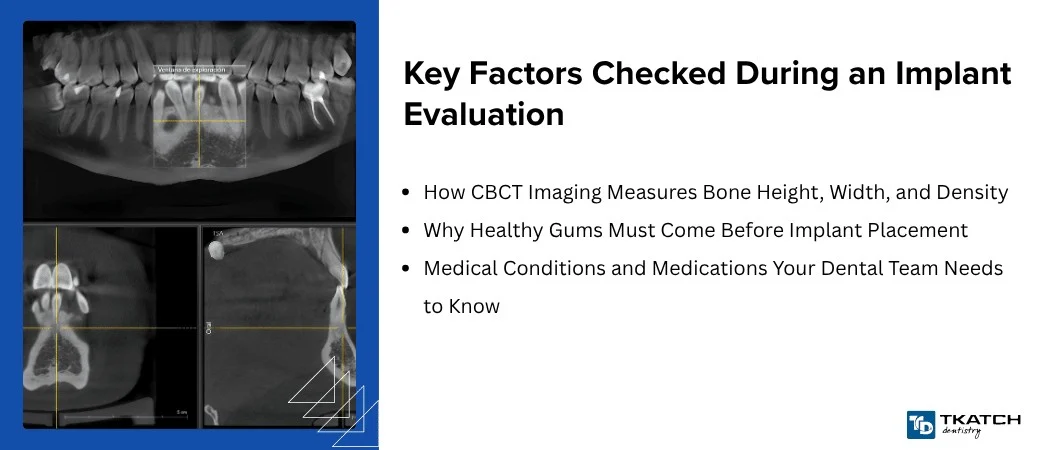
A cone beam CT scan (CBCT) is a 3D X-ray that takes about 20 to 40 seconds and shows your jaw from every angle. Regular flat X-rays cannot show bone width, and width is what determines whether a standard implant fits.
Your dentist reads three measurements from that scan:
- Bone height: how much vertical bone sits above the nerve in the lower jaw or below the sinus in the upper jaw
- Bone width: the thickness of the ridge, since a typical implant needs roughly 6 mm of width to have bone on both sides
- Bone density: how solid the bone is, which affects initial implant stability and how long you wait before loading the crown
The scan also maps your sinus floor and the nerve canal in your lower jaw so the surgeon can plan placement without touching either.
If the numbers come up short in one area, that is when grafting or a different implant design enters the conversation.
Why Healthy Gums Must Come Before Implant Placement
Implants do not get cavities, but the gum and bone around them get infected the same way natural teeth do. Placing an implant into a mouth with active periodontitis sets it up to fail.
Your evaluation should include probing depths around remaining teeth, a check for bleeding gums, and treatment of any untreated cavities. Gum therapy first, implant second.
If you struggle with dexterity from arthritis or a tremor, mention it now. That affects which restoration design your dentist recommends, since some are far easier to clean than others.
A routine cleaning and prevention schedule before surgery also gives your dentist a baseline for how your tissue responds.
Medical Conditions and Medications Your Dental Team Needs to Know
Bring your full prescription list, including supplements, to the consultation. A few categories change the plan.
| Condition or medication | What it affects | Typical approach |
| Controlled diabetes (A1C under 7-8) | Wound healing, infection risk | Proceed; coordinate with physician |
| Bisphosphonates (Fosamax, Boniva, Actonel) | Bone remodeling | Oral forms usually fine; IV forms need review |
| Blood thinners (warfarin, apixaban) | Bleeding during surgery | Physician may adjust dose briefly |
| Heart disease | Surgical stress, medication interactions | Cardiology clearance, especially after a recent event |
| Immunosuppressants, steroids | Healing speed, infection defense | Specialist records before scheduling |
| Rheumatoid arthritis, autoimmune conditions | Healing, home cleaning ability | Proceed when well managed |
None of these rules you out on its own. What they require is a phone call between your dentist and your prescribing physician, which any experienced implant practice handles regularly.
If you take an osteoporosis drug, this look at dental implants with diabetes or osteoporosis covers what that coordination involves.

How the Implant Process and Healing May Differ After 60
The surgery itself is identical at 65 and at 40: same titanium posts, same abutments, same crown materials.
What shifts is the pacing, with a few extra weeks built into healing and more attention paid to medical clearance before the appointment.
From Implant Placement to the Final Crown
Placement takes roughly 30 to 60 minutes per implant. The surgeon numbs the area, makes a small opening in the gum, prepares a channel in the bone, and threads in the implant, which acts as an artificial tooth root.
The gum is closed and you go home the same day. After the bone fuses to the post, you return for the abutment, a small connector that sticks up through the gum.
An impression or digital scan is taken, and a few weeks later your custom crown goes on. Start to finish, a single implant commonly runs four to eight months.
If you are curious about the day-to-day, here is what to expect after getting dental implants.
How Osseointegration and Healing Timelines Work
Osseointegration means your bone grows directly against the implant surface and locks it in place. That takes three to six months in most cases, and dentists lean toward the longer end when bone density is lower.
Soft tissue healing is quicker. Younger patients often feel normal within a week; after 60, plan on 10 to 14 days before things settle fully.
Your dentist checks implant stability before attaching anything to it. Some cases allow a temporary tooth right away; others need the implant left undisturbed. That call depends on how tight the implant felt when it went in.
Anesthesia, Sedation, and Recovery Planning
Most single implants are placed with local anesthesia alone, the same numbing used for a filling. You feel pressure, not pain.
Sedation is available if you feel anxious or need several implants in one visit. If you are sedated, you will fast for six to eight hours beforehand and need someone to drive you home.
Practical planning matters more than the surgery: arrange a ride, stock soft foods, fill the prescriptions ahead of time, and pause any medications only when your physician tells you to. Plan a quiet day or two afterward.
What if Bone Loss or Dentures Have Changed Your Jaw?
Bone loss narrows your options; it rarely eliminates them.
The jaw shrinks after tooth loss because it no longer gets stimulation from chewing forces, and most of that resorption happens within the first few years, which is why long-term denture wearers often need extra steps.
When Bone Grafting or a Sinus Lift May Help
Bone grafting adds material to a thin or short ridge so it can hold an implant. The graft acts as a scaffold, and your own bone grows into it over four to nine months depending on the size.
A sinus lift is a specific graft in the upper back jaw. The sinus floor is gently raised and bone is placed underneath, creating the height a molar implant needs.
Smaller grafts are sometimes done at the same appointment as implant placement. Larger ones happen first, with a healing period before surgery.
Reading up on bone grafting after tooth loss helps you know which version applies to you, and a bone graft procedure is a routine part of oral surgery.
Implant Options for Limited Jawbone Support
Standard endosteal implants sit in the jawbone and cover most cases. When bone is limited, other designs come into play.
- Mini dental implants: narrower posts that fit thinner ridges, often used to stabilize a lower denture
- Angled full-arch implants: rear implants tilted to catch denser bone, avoiding grafting in many upper jaws
- Zygomatic implants: long implants anchored into the cheekbone when the upper jaw has severe resorption
- Subperiosteal implants: a custom frame that rests on top of the bone under the gum, used in rare cases with very little bone
Zygomatic and subperiosteal placement calls for a surgeon with specific training. Ask how many the practice has placed.
Choosing Single-Tooth, Bridge, or Full-Arch Treatment

One missing tooth gets one implant and one crown. Several missing teeth in a row can be restored with an implant-supported bridge using two implants to carry three or four teeth, which costs less than one implant per tooth.
A full arch is where the biggest decisions live. Four to six implants can support a fixed bridge that stays in your mouth, or an overdenture that snaps onto the implants and comes out for cleaning.
Overdentures cost less and are easier to clean; fixed arches feel closest to natural teeth.
Comparing implant supported dentures vs dentures helps clarify the tradeoff, and there are other options for multiple tooth replacement worth reviewing with your dentist.
How to Protect Your Implant Investment for Years
Implants last decades when the gum and bone around them stay healthy, and they fail when that tissue gets infected. Your home routine and your checkup schedule carry most of the weight here.
Daily Cleaning Habits That Support Gum Health
Brush twice a day and clean between the teeth once a day, paying attention to where the crown meets the gum. That junction is where plaque hides.
An electric toothbrush helps if your grip or wrist strength has changed, since it does the scrubbing motion for you. A water flosser reaches under bridges and around full-arch restorations where string floss cannot go.
Interdental brushes, the tiny bottle-brush picks, work well between implant crowns. Ask your hygienist to size them for you at your next visit; the wrong size does not clean and can irritate the gum.
Keep professional cleanings at three to six month intervals. Hygienists use plastic or titanium instruments on implants so the surface does not get scratched.
Recognizing Early Signs of Peri-Implantitis
Peri-implantitis is infection and bone loss around an implant. It starts quietly, which is why checkups matter more than symptoms.
Watch for bleeding when you brush near the implant, gums that look puffy or red, a bad taste, pus, gum recession that exposes metal, or any sense that the crown has shifted. Pain often shows up late.
Caught early, it is treated with deep cleaning and sometimes antibiotics. Caught late, the implant may need removal.
If something feels off, this rundown of dental implant failure signs is worth a read before your appointment.
Costs, Insurance, and Financing Options
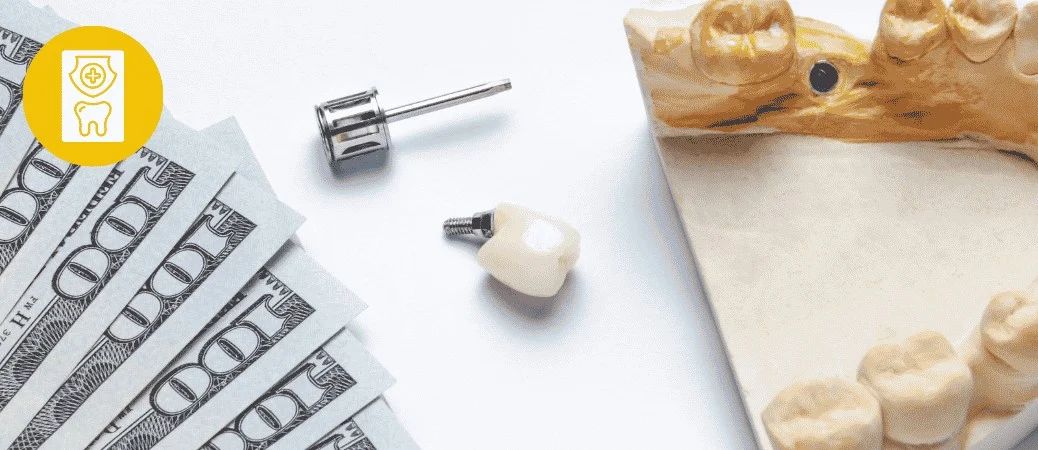
The cost of dental implants depends on factors such as how many teeth need to be replaced and whether additional procedures, such as bone grafting, are needed.
Tkatch Dentistry provides financing options through CareCredit, Proceed Finance, Cherry Payment Plans, DentalHQ, and Sunbit. These options can allow eligible patients to spread treatment costs over time.
For patients without dental insurance, Tkatch Dentistry also offers a dental membership plan.
The plan is not dental insurance, but it includes preventive care and a 10% discount on additional treatment, excluding products.
Before starting implant treatment, ask the dental team to review your expected costs, insurance benefits, and available financing options so you understand your choices.
A Personalized Plan Can Make Implants Possible After 60
Implant candidacy after 60 comes down to specifics that a consultation can measure: how much jawbone you have, whether your gums are healthy, how stable your medical conditions are, what you take daily, and how you will keep the restoration clean.
Bone loss and long-term denture wear add steps like grafting or a different implant design. Diabetes, osteoporosis drugs, and blood thinners add coordination with your physician.
Neither category is a stop sign on its own.
Bring your medication list and recent lab work to your consultation, ask for a CBCT scan, and request a written treatment sequence with timelines and an itemized cost estimate.
If grafting is recommended, ask what happens if you decide against it and whether another approach may be appropriate.
At Tkatch Dentistry, our experts evaluate your jawbone, oral health, and individual needs to help determine which dental implant approach may be right for you.
Frequently Asked Questions
At what age should you stop getting dental implants?
There is no upper age limit for dental implants. Patients in their 80s and 90s receive them successfully when they have adequate bone, healthy gums, and stable medical conditions.
Your dentist evaluates healing capacity and health status instead of applying an age cutoff.
Are dental implants worth it for seniors?
For most older adults with missing teeth, yes. Implants restore chewing efficiency that loose dentures cannot match, which supports better nutrition, and they preserve jawbone that would otherwise keep shrinking.
The main tradeoff is cost and the multi-month timeline.
How long does healing take after dental implant surgery for someone over 60?
Soft tissue soreness settles in about 10 to 14 days, a few days longer than in younger patients.
Osseointegration, the bone fusing to the implant, takes three to six months, and your dentist may choose the longer end if bone density is lower. Grafting adds four to nine months before implant placement.
Can I get dental implants if I have osteoporosis or take bisphosphonates?
Yes in most cases, especially with oral bisphosphonates like Fosamax, Boniva, or Actonel.
These drugs slow bone remodeling, so your dentist and physician will coordinate on timing and sometimes a brief medication pause. High-dose IV forms used in cancer care carry more risk and require careful review.
Can people with diabetes or blood thinners get dental implants?
Both groups routinely get implants. Well-controlled diabetes with an A1C under 7 to 8 shows success rates close to those of non-diabetic patients, while uncontrolled blood sugar slows healing and raises infection risk.
With warfarin or newer anticoagulants, your physician may adjust the dose briefly around the surgery date.
When are dental implants most likely to fail?
Failures cluster in two windows: the first few months, when the implant does not fuse with the bone, and years later, from peri-implantitis.
Smoking, uncontrolled diabetes, untreated gum disease, poor home cleaning, and heavy grinding raise the risk in both windows. Regular checkups catch the late type while it is still treatable.